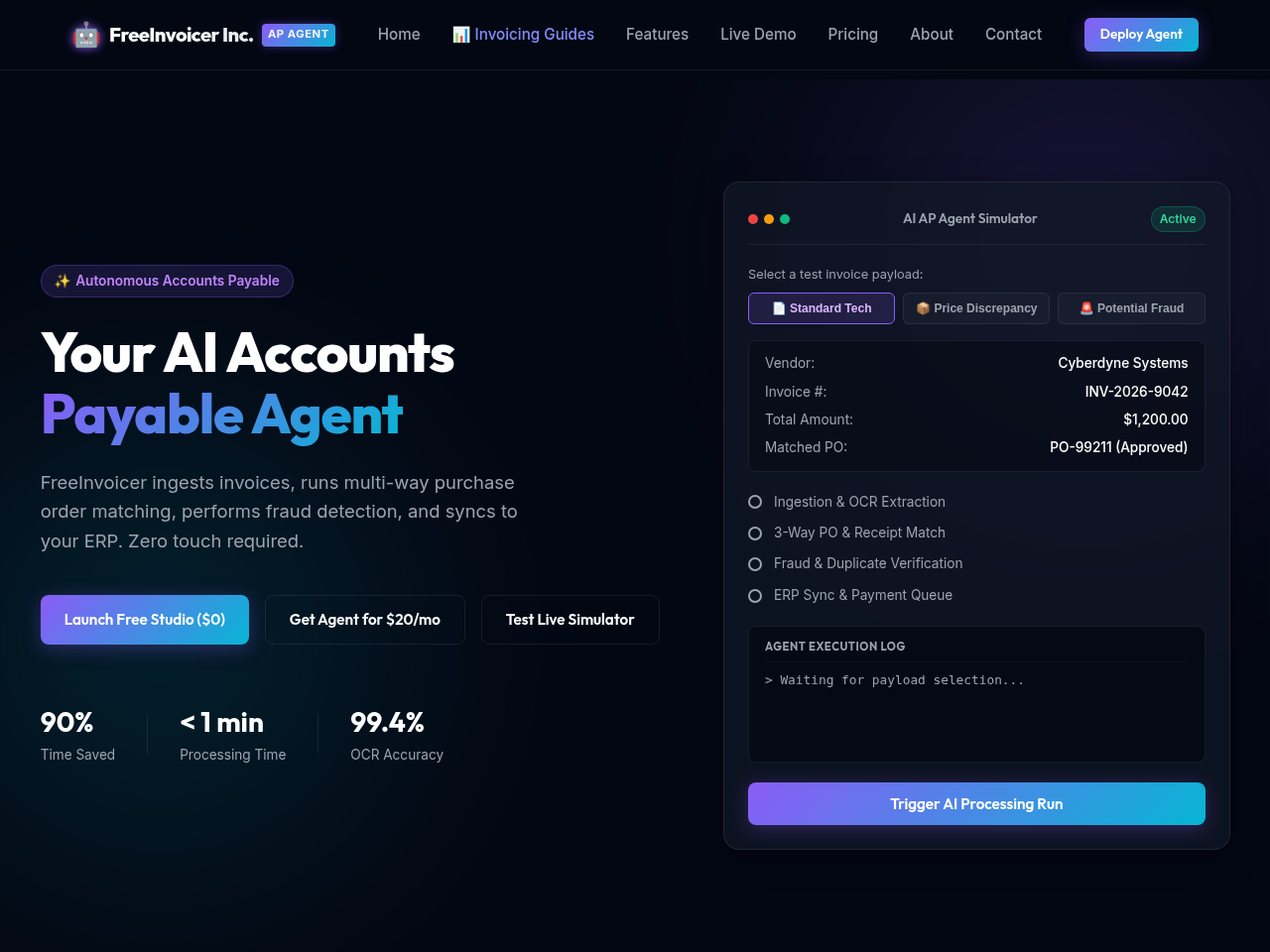
The Core Safeguard of Procure-to-Pay (P2P) Systems
In mid-market and enterprise organizations, the procure-to-pay (P2P) lifecycle processes tens of thousands of commercial purchase orders annually. Historically, reconciling incoming supplier invoices against authorized procurement contracts was a manual, paper-intensive slog. Accounts payable clerks manually matched paper invoices with carbon-copy warehouse receiving slips and signed purchase order forms.
Manual reconciliation introduces severe operational failure modes: companies routinely pay for items never delivered, accept unauthorized price hikes, or duplicate payments on partial shipments. Conversely, manual bottlenecks delay payment approvals, causing suppliers to halt critical shipments and forfeiting lucrative early payment discounts.
Automated 3-Way Matching Algorithms eliminate manual reconciliation. By cross-referencing digital line items across the Purchase Order (PO), the Goods Receipt (GR), and the Supplier Invoice, algorithmic matching engines achieve straight-through processing rates exceeding 80%, reserving human intervention strictly for genuine pricing and quantity exceptions.
The 3-Way Matching Mathematical Engine
The algorithmic matching engine evaluates incoming invoice lines against open purchase order lines and recorded warehouse receipts according to strict tolerance bounds:
export interface PurchaseOrderLine {
  poLineId: string;
  sku: string;
  orderedQuantity: number;
  unitPrice: number;
  openQuantity: number; // Remaining unbilled quantity
}

export interface GoodsReceiptLine {
  receiptId: string;
  sku: string;
  receivedQuantity: number;
  acceptedQuantity: number; // Excludes damaged or rejected goods
}

export interface InvoiceLine {
  sku: string;
  invoicedQuantity: number;
  invoicedUnitPrice: number;
}

export interface MatchEvaluationResult {
  isMatch: boolean;
  status: 'MATCH_EXACT' | 'MATCH_WITHIN_TOLERANCE' | 'PRICE_MISMATCH' | 'QUANTITY_EXCEEDED' | 'UNRECEIVED_GOODS';
  priceVariancePct: number;
  quantityVariance: number;
}

export function evaluateThreeWayMatch(
  poLine: PurchaseOrderLine,
  receiptLine: GoodsReceiptLine,
  invoiceLine: InvoiceLine,
  priceTolerancePct: number = 0.02, // 2% tolerance
  dollarToleranceMax: number = 15.00
): MatchEvaluationResult {
  // Check 1: Invoiced quantity cannot exceed accepted received quantity
  if (invoiceLine.invoicedQuantity > receiptLine.acceptedQuantity) {
    return {
      isMatch: false,
      status: 'UNRECEIVED_GOODS',
      priceVariancePct: 0,
      quantityVariance: invoiceLine.invoicedQuantity - receiptLine.acceptedQuantity
    };
  }

  // Check 2: Invoiced quantity cannot exceed open PO quantity
  if (invoiceLine.invoicedQuantity > poLine.openQuantity) {
    return {
      isMatch: false,
      status: 'QUANTITY_EXCEEDED',
      priceVariancePct: 0,
      quantityVariance: invoiceLine.invoicedQuantity - poLine.openQuantity
    };
  }

  // Check 3: Unit price variance analysis
  const unitPriceDelta = invoiceLine.invoicedUnitPrice - poLine.unitPrice;
  const priceVariancePct = Math.abs(unitPriceDelta / poLine.unitPrice);
  const totalDollarVariance = Math.abs(unitPriceDelta * invoiceLine.invoicedQuantity);

  if (unitPriceDelta === 0) {
    return { isMatch: true, status: 'MATCH_EXACT', priceVariancePct: 0, quantityVariance: 0 };
  }

  // Evaluate tolerance ceiling
  if (priceVariancePct <= priceTolerancePct || totalDollarVariance <= dollarToleranceMax) {
    return {
      isMatch: true,
      status: 'MATCH_WITHIN_TOLERANCE',
      priceVariancePct,
      quantityVariance: 0
    };
  }

  return {
    isMatch: false,
    status: 'PRICE_MISMATCH',
    priceVariancePct,
    quantityVariance: 0
  };
}
Handling Complex Real-World Procurement Scenarios
Real-world supply chains deviate frequently from simple 1-to-1 matching. Production 3-way matching algorithms must elegantly manage non-standard conditions:
- Partial Deliveries & Staggered Invoicing: A supplier fulfills an order of 1,000 widgets across three separate shipments over two months. The matching engine dynamically decrements
openQuantityon the PO line item after each receipt and invoice match, preventing double-billing on remaining balances. - Blanket Purchase Orders & Call-Off Contracts: Long-term consulting or raw material agreements define an annualized spending cap rather than discrete item quantities. The engine executes 2-Way Monetary Matching against approved project milestones.
- Freight, Handling & Miscellaneous Surcharges: Suppliers frequently append unpredicted fuel surcharges or pallet fees. Configurable tolerance rules absorb variances below defined corporate dollar thresholds (e.g. <$25), while routing excessive surcharges to purchasing agents for formal approval.
Automated Accrual Reversals in Financial Accounting
In standard accrual accounting, when goods arrive at a warehouse, the ERP system posts a journal entry debiting Inventory and crediting Received Not Invoiced (RNI) / Goods Receipt/Invoice Receipt (GR/IR) clearing accounts.
When the 3-way matching engine successfully validates the supplier invoice, the accounting module automatically executes the accrual clearing entry: debiting the GR/IR clearing account, debiting or crediting price variance sub-ledgers, and crediting Accounts Payable. By automating the reconciliation loop, the enterprise eliminates month-end manual accrual adjustments and ensures pristine financial statements.
Automated Exception Routing & Supplier Self-Service
When an invoice fails 3-way matching (e.g. the supplier charged $120 per unit instead of the contractually agreed $100), automated routing engines assign the discrepancy directly to the purchasing manager who originated the purchase order. The manager can approve the price variance with a formal justification code or generate an automated Debit Memo (Short-Pay Notice) back to the supplier, automatically deducting the disputed $20 per unit from the remittance advice.
Dynamic Tolerance Matrices Based on Vendor Trust Scores
Static tolerance thresholds (e.g. 2% price variance across all suppliers) fail to account for differing supplier risk profiles. A multi-national utility or tier-1 strategic supplier with five years of flawless billing history should not trigger manual hold queues for a $2.50 rounding discrepancy.
Advanced AP platforms implement Dynamic Trust-Weighted Tolerance Matrices. Machine learning engines evaluate vendor reliability scores based on historical discrepancy frequency, return rates, and financial stability. Highly trusted vendors receive expanded automated tolerance windows (e.g. up to $50 or 3%), whereas newly onboarded or historically erratic suppliers face strict 0% zero-tolerance validation gates.
Non-PO Invoice Workflows: Automated 2-Way Approval Routing
While direct manufacturing inventory spend mandates strict 3-way matching, indirect operational expenditures—such as legal retainers, software subscriptions, or executive travel—often operate without formal purchase orders. If left unmonitored, non-PO spend becomes an unmanaged source of budget leakage.
Modern P2P platforms route non-PO invoices through an automated 2-Way Approval Workflow. Using natural language processing and historical cost-center mapping, the system automatically assigns the invoice to the appropriate departmental budget owner, performs real-time general ledger (GL) coding and cost-center allocation, verifies that departmental budget ceilings remain unbreached, and captures cryptographic electronic sign-off prior to cash disbursement.
Automated Early Payment Discount Capture During 3-Way Reconciliation
One of the highest return-on-investment capabilities of automated 3-way matching is unlocking early payment discounts (such as 2/10 Net 30). In a legacy manual approval department, invoices took 15 to 25 days just to route between desk clerks, consistently missing the 10-day early pay discount window and costing organizations millions in forfeitures.
By compressing the 3-way matching reconciliation window from two weeks down to under four minutes, the automated matching engine flags eligible discount terms instantly upon PO and goods receipt verification. The payment scheduler prioritizes approved discounted invoices into the next immediate settlement cycle, locking in risk-free annualized returns exceeding 36% APR.
By replacing manual human inspection with deterministic 3-way matching algorithms, dynamic vendor trust scoring, automated non-PO approval workflows, and automated discount capture, enterprise procurement organizations eliminate overpayment leakage, accelerate payment cycles, and enforce total corporate spending discipline.